Most people spend weeks researching Maldives flights and forget to ask the most expensive question first: what kind of place should you actually stay at?
The difference between a $90-per-night local island guesthouse and a $3,500-per-night overwater villa isn’t just price. It’s a fundamentally different trip — different food, different freedom, different atmosphere. Get this wrong and you’ll either overspend on something you didn’t need, or book the wrong experience entirely and wish you’d made a different call.
Here’s what you need to know before you book.
The 4 Types of Maldives Accommodation Side by Side
Before anything else, here’s the landscape. Four distinct accommodation types exist in the Maldives, each with a completely different model for how your stay works.
Quick Comparison: All Four Types
| Type | Price Per Night | Best For | Key Trade-off | Example Property |
|---|---|---|---|---|
| Overwater Villa | $800–$3,500+ | Honeymoons, milestone trips | Very expensive; isolated | Soneva Jani, Conrad Maldives |
| Beach Villa (Resort) | $400–$1,200 | Families, beach-first travelers | No private water access | Gili Lankanfushi, Coco Bodu Hithi |
| Local Island Guesthouse | $60–$200 | Budget travelers, culture seekers | Public beaches; no alcohol | Maafushi guesthouses, Guraidhoo |
| Liveaboard Boat | $150–$450 (all-inclusive) | Divers, serious snorkelers | Small cabins; constant movement | Emperor Maldives, MV Carpe Diem |
The resort category splits further into overwater and beach villa options — which is why most booking sites feel confusing. They’re different products sometimes sold on the same island, even at the same resort.
What “Full Board” Really Means Here
Most Maldives resorts operate on a full board or all-inclusive basis because you’re on a private island. There’s nowhere else to eat. A $600/night beach villa with full board included can easily be cheaper in total than a $400/night villa where meals add $150–$200 per person per day.
Always compare total trip costs, not just the headline room rate.
Why Overwater Bungalows Cost $800+ Per Night — And When They’re Worth It
The short answer: construction, logistics, and zero local competition.
Building over open water requires marine engineering, special permits, and far more material and labor than a ground-level structure. Pontoons need constant maintenance. Plumbing runs underwater. Every supply — food, linens, toiletries — arrives by boat or seaplane to a remote atoll. The resort owns the island. There’s no alternative restaurant down the road. Prices start high because they can.
But here’s what you’re actually buying.
The Real Value of an Overwater Villa
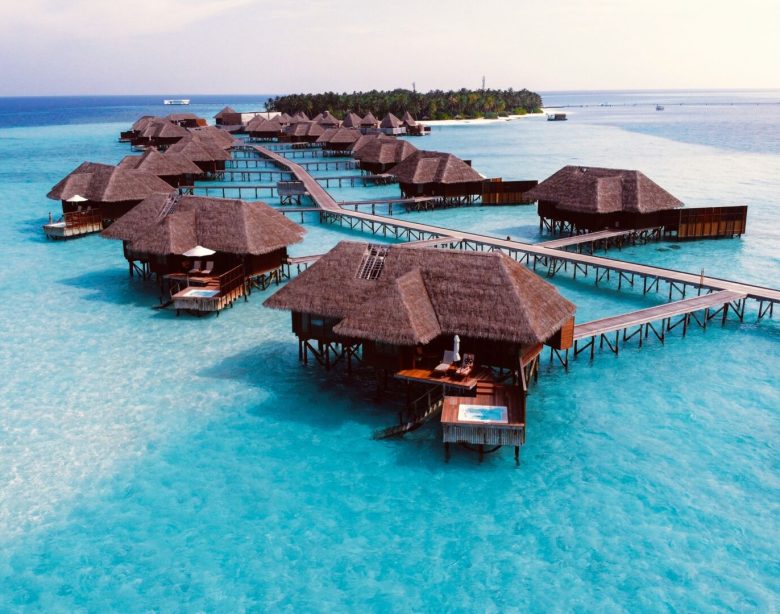
At properties like Soneva Jani (from $3,500/night in Noonu Atoll) or Conrad Maldives Rangali Island (from $1,100/night), your villa sits directly above a clear lagoon. You wake up and step off your private deck into the water. No walking to the beach. No towel-on-chair territory disputes. No other guests within eyeline. The deck is yours. The view is unobstructed. For a honeymoon or a significant anniversary, that combination is genuinely hard to replicate anywhere else.
Mid-range options also exist. Holiday Inn Resort Kandooma offers overwater villas from around $350/night — far less than luxury competitors, with a solid house reef and reliable infrastructure. The villa isn’t large and the finishes aren’t premium, but you get direct lagoon access, which is the defining feature of the experience.
When an Overwater Villa Is the Wrong Choice
If you’re traveling with children under 12, overwater villas become a constant safety anxiety. Most have open-railed decks with a direct drop into deep water. Several resorts won’t allow children under 12 in overwater accommodation at all.
If snorkeling is your main priority, check before booking. Many overwater villas are positioned in shallow lagoons with sandy bottoms — not coral. A beach villa with better reef access can deliver superior snorkeling at a lower price point.
And if you’re motion-sensitive: some overwater structures rock noticeably in swell. Ask the specific property about this before committing.
Local Island Guesthouses Deliver More Than Most Travelers Expect
Honest take: for first-time visitors on a realistic budget, a local island guesthouse on Maafushi or Guraidhoo delivers roughly 80% of the Maldives experience at around 15% of the cost.
The water is the same water. The reefs are often excellent — Maafushi has multiple dive sites within 15 minutes by boat and a popular sandbank excursion. Day trips to snorkel spots, dolphin cruises, and private sandbanks run $30–$60 per person. The guesthouses themselves have improved significantly over the past decade. Many now offer air conditioning, en-suite bathrooms, and ocean-view rooms for $80–$150/night.
The Real Trade-off You Need to Understand
The Maldives is a Muslim country. On local islands, alcohol is not available and beachwear must be covered when walking through the village. Designated bikini beaches exist — usually a small patch on the edge of the island — but they’re public and shared with other guests and day visitors.
If you want to sunbathe in a swimsuit with direct access from your room, sunset cocktails, and a beach to yourself, a guesthouse won’t work. That combination requires a resort. But if you’re a solo traveler, a couple watching their budget, or someone genuinely curious about Maldivian life beyond the curated resort version, local islands are far more interesting than the standard tourist narrative gives them credit for.
Best Islands for Guesthouse Stays
Maafushi is the most developed and easiest to navigate — lots of English speakers, multiple dive operators, consistent guesthouse quality. Dhigurah is better for whale shark encounters, which are common between January and April. Thoddoo is smaller and quieter, known for fruit farms and a genuinely relaxed atmosphere.
5 Mistakes That Cost Maldives Travelers Thousands
- Ignoring transfer type when comparing prices. Some resorts require a seaplane transfer ($300–$600 per person, round trip) just to reach the island. That cost sits on top of your room rate. A $500/night room with a $600 seaplane transfer is not a budget option.
- Assuming “overwater” means great snorkeling. Many overwater villas are built in shallow lagoons with sandy bottoms and minimal coral. If reef access matters to you, ask specifically about house reef proximity before booking any overwater unit.
- Not factoring in meal costs. On a private resort island, food isn’t optional — there’s nowhere else to eat. If your rate excludes meals, add $80–$200 per person per day before calculating what the trip actually costs.
- Booking peak-season dates without checking weather patterns. December to April is dry season. May to October brings lower rates but more cloud cover and intermittent heavy rain. Neither season is universally bad — but you should book knowing which one you’re getting into.
- Choosing a resort based on overwater villa photos, then booking a beach villa. Most resorts shoot all their marketing imagery around their overwater units. Beach villas are a different experience. Check that the photos you’re basing your decision on match the actual room category you’re booking.
How to Match Accommodation to Your Actual Travel Style
You’re honeymooning or marking a major milestone — what do you book?
An overwater villa at a resort with a strong romance track record. Gili Lankanfushi (from $1,200/night, no shoes required, no news policy) and Cheval Blanc Randheli (from $2,000/night) consistently top independent reviews in this category. The isolation, private deck, and dedicated villa host are exactly what this type of stay is designed for. Don’t compromise on the room category — book the overwater unit you actually came for.
You want serious diving and don’t care much about beach time — what do you book?
A liveaboard, without question. The Emperor Maldives fleet covers multiple atolls and reaches dive sites that shore-based resorts can’t easily access. Pricing runs $150–$380 per person per day, all-inclusive. Cabins are compact but functional. You wake up at a different dive site every morning. For divers, this is the objectively superior choice over any land-based option.
You want the Maldives on a tight budget — what do you book?
A Maafushi guesthouse. Budget around $150–$200 per day total including accommodation, food, and activity day trips. A full week comes in under $1,500. A mid-range resort week runs $5,000–$8,000 before flights. The ocean is the same ocean.
You’re traveling with children under 12 — what do you book?
A resort beach villa. Ozen Reserve Bolifushi (full-board from $700/night) has excellent family programming, shallow lagoon areas safe for young swimmers, and beach villas with enough space for a family of four. Overwater units and young kids are a stressful combination — skip it.
Seaplane vs. Speedboat: The Budget Item Nobody Warns You About
Resorts within 45 minutes of Malé by speedboat are dramatically cheaper to reach than those in outer atolls requiring a seaplane flight — and seaplane transfers through operators like Manta Air or Trans Maldivian Airways run $280–$600 per person round trip, adding up to $1,200 for two people before you’ve seen your room. If budget matters even slightly, filter for speedboat-access resorts before you fall in love with a property that requires a seaplane to reach it.
The Best Properties in Each Category Right Now
These aren’t sponsored recommendations. These are the properties that appear consistently at the top of independent travel reviews in 2026, across each accommodation type.
Best Luxury Overwater Villa: Soneva Jani
Soneva Jani in Noonu Atoll sets the current benchmark. A water slide from your villa deck. A retractable roof above the bed for stargazing. Villa options from one to four bedrooms. Rates start around $3,500/night but include meals, non-motorized watersports, and most excursions. If you’re committing to this price range, this is where the money is best spent right now.
Best Mid-Range Resort: Coco Bodu Hithi
Coco Bodu Hithi in North Malé Atoll hits a genuine sweet spot — design-forward rooms, a strong house reef, and both overwater and beach villa options starting around $600/night with half board. Speedboat access from Malé (45 minutes) keeps transfer costs low. Consistent across multiple independent platforms over several years, which matters more than a single glowing review.
Best Budget Option: Maafushi Guesthouses
Several guesthouses on Maafushi deliver solid quality at $80–$130/night. Prioritize properties offering air conditioning, private bathrooms, and ocean-facing rooms — not all budget options include these by default. The island has multiple dive centers, a bikini beach, and numerous boat tour operators, making it straightforward to fill a full week with activity.
Best Liveaboard: Emperor Maldives
Emperor Maldives operates multiple vessels across different atolls and dive seasons. Their South Atolls route between November and April is particularly strong for hammerhead sharks and manta rays. All-inclusive pricing runs $200–$380 per person per day depending on vessel class and season. The cabins are small — that’s the tradeoff for waking up at dive sites no shore-based resort can touch.
The gap between budget and luxury Maldives travel is narrowing faster than most people realize. Local guesthouses that once felt like a compromise now offer genuine quality. Mid-range resorts have expanded dramatically. The old assumption that you need $10,000 to have a real Maldives trip is simply outdated — but only if you choose the right accommodation type for what you actually want from the trip.