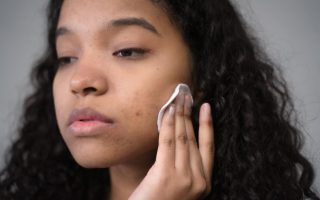
You can set your calendar by it. Ten days before your period, a deep, throbbing bump forms along your jawline. It sits there for two weeks, never comes to a head, and leaves a dark mark that finally fades just in time for the next one to arrive. Hormonal chin acne is not a hygiene problem. It is a biology problem, and it responds to a completely different playbook than the blackheads on your nose.
This guide covers the exact four-step routine that actually works for hormonal chin acne, the two prescription options worth asking a doctor about, and the mistakes that keep people stuck in a cycle of angry, painful breakouts for years. No vague advice. Specific products, specific timelines, specific verdicts.
The Four-Step Routine That Actually Works for Chin Breakouts
Most people with hormonal chin acne are doing too much. They layer five active ingredients, dry their skin out, and then wonder why their chin is still breaking out while their cheeks are peeling. The routine below is built around one principle: reduce inflammation first, prevent new lesions second, and protect the barrier always. You can add more later, but start here.
Step 1: Wash With a 4% Benzoyl Peroxide Cleanser (Morning Only)
Benzoyl peroxide is the single best over-the-counter ingredient for the deep, painful bumps on your chin. It kills Cutibacterium acnes, the bacteria that colonize clogged pores and trigger the inflammatory cascade that makes hormonal acne so red and swollen. A cleanser form is less irritating than a leave-on cream, and that matters when your chin is already inflamed.
Use PanOxyl Acne Foaming Wash 4% Benzoyl Peroxide ($12, available at most drugstores). Work it into wet skin, leave it on for 60 to 90 seconds before rinsing, and then rinse thoroughly. Do this once a day, in the morning. Using it twice a day will wreck your barrier and make everything worse. If your skin is very sensitive, switch to CeraVe Acne Foaming Cream Cleanser 4% Benzoyl Peroxide ($15), which has a creamier base and is less drying.
Step 2: Apply Adapalene 0.1% Gel at Night
Adapalene is the only prescription-strength retinoid available over the counter in the United States. It works by speeding up cell turnover inside the pore, which prevents the plug from forming in the first place. Hormonal acne is driven by androgens that make your skin cells stickier and your oil thicker. Adapalene directly counteracts both of those effects. It will not stop the hormonal trigger, but it stops the trigger from turning into a visible bump.
Use Differin Gel 0.1% Adapalene ($15 for a 15g tube, lasts about 3 months). Apply a pea-sized amount to your entire chin and jawline every night, not just on active spots. This is a prevention tool, not a spot treatment. Expect purging for the first 3 to 6 weeks. That means existing clogged pores come to the surface faster. It is unpleasant, but it is a sign the product is working. Push through to week 8 before judging it.
Step 3: Spot Treat With a Sulfur Mask or Pimple Patch
When a deep bump is already forming, you need something to calm it down without drying the surrounding skin into a flaky mess. Sulfur is the most underrated ingredient for hormonal acne. It reduces inflammation, draws out excess oil, and does not cause the burning or peeling that benzoyl peroxide leave-on creams do.
Use De La Cruz 10% Sulfur Ointment ($8 for a 2.6oz jar) as a 10-minute mask on the affected area, then rinse. Do this once every other day on active breakouts. For whiteheads that have come to a head, use Mighty Patch Original Hydrocolloid Patches ($13 for 36 patches) overnight. They absorb the fluid and keep you from picking, which is the number one cause of post-acne dark marks on the chin.
Step 4: Moisturize With a Barrier-Safe Formula
Everything above is drying, and dry skin produces more oil to compensate. That oil then gets trapped under the dry, flaky layer and creates new clogs. You must moisturize twice a day, even if your chin feels oily. Use La Roche-Posay Toleriane Double Repair Face Moisturizer ($20 for 100ml). It has ceramides and niacinamide, both of which help calm inflammation and rebuild the barrier you are actively stressing with actives. Apply it after your morning wash and after your nighttime adapalene.
When Over-the-Counter Is Not Enough: The Prescription Tier

Some hormonal chin acne does not respond to topicals, no matter how consistent you are. If you have done the four-step routine for 12 full weeks and you are still getting deep, painful nodules every month, the problem is systemic. The androgens are producing too much oil and too much inflammation for any cream to fully control. That is when you move to prescription options.
Spironolactone: The Hormonal Blocker
Spironolactone is an oral medication that blocks androgen receptors in your skin. It is prescribed off-label for hormonal acne in women, and it is the single most effective treatment for the deep, cystic chin and jawline breakouts that follow your menstrual cycle. Typical starting dose is 50mg per day, often increased to 100mg. Results take 3 to 6 months. Side effects include increased urination, breast tenderness, and irregular periods in some people. You cannot take it if you are pregnant or trying to conceive.
Winlevi: Topical Spironolactone, Basically
Winlevi (clascoterone) 1% cream is a newer prescription topical that blocks androgens directly in the skin, without the systemic effects of the pill. It is applied twice daily and has a much lower side effect profile than oral spironolactone. The downside is cost: without insurance, a 60g tube runs around $500. With insurance, it is often $30 to $75. If you cannot tolerate oral medication or want to avoid systemic hormones, this is the best topical option available in 2026.
The Mistakes That Keep Chin Acne Coming Back
Here is what I see people do wrong, over and over, in forums and in person. These five mistakes are why people try a routine for two weeks, see no change, and quit.
- Picking or squeezing deep nodules. You cannot pop a cystic pimple. There is no core to extract. Squeezing it just ruptures the follicle wall deeper in the skin, spreads inflammation, and guarantees a dark mark that lasts months. Leave it alone or use a sulfur mask.
- Using leave-on benzoyl peroxide every night. A 10% BP cream applied to the entire chin will burn the skin, trigger massive peeling, and make inflammation worse. The cleanser form is enough for most people.
- Cutting dairy and sugar but changing nothing else. Diet can play a role, but it is usually a minor one compared to hormones. If you cut dairy and see no change in 8 weeks, the problem is not dairy. Move on to the treatments above.
- Stopping adapalene at week 4 because of the purge. The purge peaks at week 4 to 6. Quitting then is like leaving the gym right before the muscle starts to build. Week 8 is the minimum evaluation point.
- Over-cleansing to “dry out” the acne. Hormonal acne is not caused by surface oil. Washing your face three times a day strips the barrier, triggers rebound oil production, and makes the inflammation worse. Twice a day, max.
Chin Acne vs. Maskne vs. Fungal Acne: How to Tell the Difference

Not everything on your chin is hormonal. If you treat the wrong type of acne, you will waste months and make it worse. Here is the quick differential.
| Feature | Hormonal Chin Acne | Maskne (Irritant Acne) | Fungal Acne (Malassezia) |
|---|---|---|---|
| Location | Chin, jawline, lower cheeks | Anywhere a mask or fabric touches | Forehead, chest, upper back |
| Lesion type | Deep, painful nodules or cysts | Small red bumps, some whiteheads | Uniform tiny bumps, often itchy |
| Timing | Cyclical, tied to menstrual cycle | Constant, tied to friction or sweat | Constant, worsens with humidity |
| Responds to | Adapalene, BP, spironolactone | Barrier repair, less friction | Ketoconazole, zinc pyrithione |
| Does NOT respond to | Salicylic acid alone | Strong actives (makes it worse) | Benzoyl peroxide, adapalene |
If your chin bumps are itchy, uniform in size, and never come to a head, consider fungal acne. Try washing the area with Nizoral Anti-Dandruff Shampoo (1% ketoconazole) ($15) as a 5-minute mask twice a week. If it clears up in two weeks, you had fungal acne, not hormonal acne.
The Timeline: What to Expect at 2, 6, and 12 Weeks

This is the part nobody tells you. Hormonal acne treatment is slow. You will not see clear skin in a week. Here is the realistic timeline for the four-step routine.
Week 2: Your skin may be slightly dry or flaky, especially around the chin. Active breakouts may look the same or slightly calmer. This is normal. Do not add more products.
Week 6: The purge is usually at its worst here if you are using adapalene. You may have more small whiteheads than before. The deep nodules are less inflamed. This is the hardest week. Most people quit here. Do not quit here.
Week 12: This is the first real checkpoint. The deep, painful cysts should be significantly reduced in frequency and severity. You may still get one or two small bumps around your period, but they should resolve faster and leave less of a mark. If you see zero improvement at week 12, move to the prescription tier.
For the fastest results, combine the topical routine with an appointment to discuss spironolactone or Winlevi at the same time. You can start the topicals while waiting for the dermatology appointment, so you are not losing time.
Final verdict: For mild to moderate hormonal chin acne, the four-step routine with PanOxyl 4% wash, Differin 0.1% gel, De La Cruz sulfur, and La Roche-Posay Toleriane moisturizer is the best over-the-counter protocol. For moderate to severe cystic acne that leaves scars, skip the trial period and ask about spironolactone at your first appointment. The longer deep nodules sit in your skin, the higher the risk of permanent scarring.