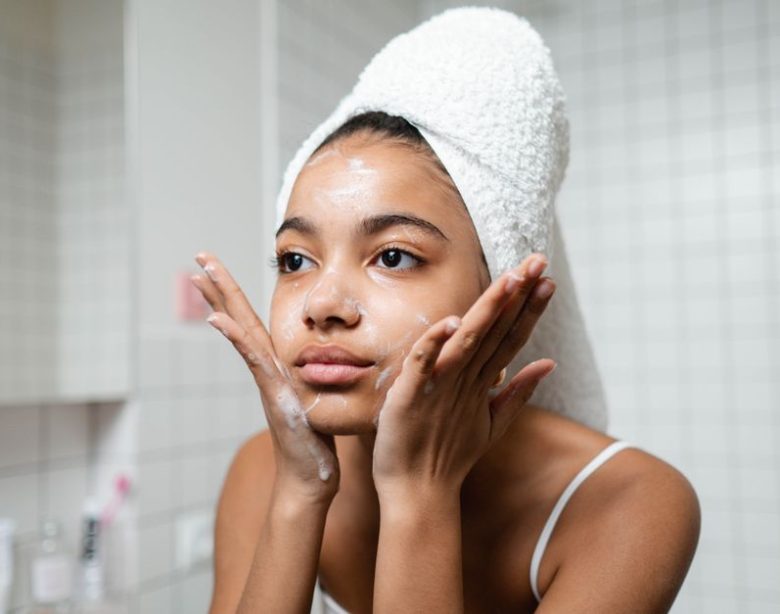
Stop washing your face. Not permanently—but if your skin stings when you apply moisturizer, looks shiny but feels tight, or flakes around your nose while your cheeks burn, your cleanser is probably making things worse. The right wash won’t fix a damaged barrier on its own. The wrong one will undo every repair product you layer afterward.
Two drugstore cleansers dominate the barrier-repair conversation: CeraVe Hydrating Facial Cleanser ($15 for 16oz) and La Roche-Posay Toleriane Hydrating Gentle Cleanser ($18 for 13.5oz). Both are marketed to sensitive, dry, compromised skin. Both are fragrance-free and non-foaming. But they’re not interchangeable—and picking the wrong one for your specific damage pattern will keep you stuck in the sting-then-moisturize cycle for months.
Here’s which one you need, and when neither is the right answer.
The Wash-Off Window: What a Barrier-Safe Cleanser Actually Needs to Do
Cleansers touch your skin for maybe 60 seconds. That’s not enough time to rebuild a barrier. It’s plenty of time to strip one further.
Your stratum corneum—the outermost skin layer—is a brick-and-mortar structure. Corneocytes are the bricks. Lipids (ceramides, cholesterol, fatty acids) are the mortar. When the mortar is depleted from over-exfoliation, retinoid misuse, or just a dry climate, water escapes and irritants enter. A cleanser’s job during barrier repair is simple: remove debris without extracting more lipids or raising pH above the skin’s natural 4.7–5.75 range.
Most “gentle” cleansers still disrupt the barrier because they use surfactants that bind to skin proteins. The damage is invisible—you won’t see suds stripping your face—but you’ll feel it 10 minutes later when your cheeks start burning.
Three questions determine whether a cleanser is barrier-safe:
- Surfactant type: Anionic surfactants (sodium lauryl sulfate, sodium laureth sulfate) denature skin proteins. Nonionic and amphoteric surfactants are less disruptive.
- pH: High-pH cleansers (8+) swell the stratum corneum and disorganize lipid bilayers. The damage lasts hours after rinsing.
- Residue: Does the formula leave behind emollients, humectants, or barrier-identical lipids that keep the skin from drying out after the water evaporates? This matters more than the wash itself.
Both CeraVe and La Roche-Posay get the surfactant and pH right. Where they diverge—and where your choice matters—is the residue profile and what happens to your face 5 minutes post-rinse.
Side-by-Side: Formula Breakdown and Post-Wash Reality
| Factor | CeraVe Hydrating Cleanser | La Roche-Posay Toleriane Hydrating Cleanser |
|---|---|---|
| Surfactant system | Behentrimonium methosulfate, sodium lauroyl lactylate (very mild, non-foaming) | Coco-betaine, PEG-120 methyl glucose dioleate (mild, minimal foam) |
| pH | 5.5 (formulation target; batch-tested around 5.2–5.8) | 5.2–5.5 (consistently tests in this range) |
| Key barrier ingredients | 3 essential ceramides (1, 3, 6-II), cholesterol, hyaluronic acid | Ceramide NP, niacinamide, glycerin, La Roche-Posay thermal spring water |
| Post-wash feel | Emollient film—some describe as “lotion-like” residue | Clean but not tight—minimal residue, more “slip” during wash |
| Preservative system | Phenoxyethanol, ethylhexylglycerin | Phenoxyethanol (higher concentration) |
| Texture | Lotion-cream, opaque, zero foam | Gel-cream, translucent, minimal lather on contact with water |
| Price per oz | $0.94/oz (16oz bottle) | $1.33/oz (13.5oz bottle) |
The CeraVe leaves a deliberate film. This is not a flaw—it’s the mechanism. Behentrimonium methosulfate is a cationic surfactant that deposits fatty material onto the skin. Combined with the ceramide-cholesterol slurry, the formula is designed to compensate for lipids you’re missing. People with extremely dehydrated, flaking, papery-textured skin often prefer this because it stops transepidermal water loss immediately post-wash.
But that film is also why some people hate it. If you have acne-prone skin, even with a compromised barrier, the residue can feel occlusive. CeraVe’s own ceramide blend includes ceramide 6-II, which some anecdotal reports link to closed-comedone formation in very clog-prone individuals. The data isn’t conclusive, but the pattern is common enough to mention.
La Roche-Posay’s cleanser rinses cleaner. The glycerin and niacinamide are humectants—they pull water in, but they don’t leave a coating. If your barrier is damaged from actives (tretinoin, acids) rather than inherent dryness, you’ll likely prefer this finish. Niacinamide at wash-off concentrations won’t transform your barrier, but it has a measurable soothing effect on inflamed skin, and the thermal spring water adds a minor anti-irritant buffer.
When the CeraVe Wins
The CeraVe Hydrating Cleanser is the better choice when your barrier failure shows up as dryness-dominant damage—meaning flaking, rough texture, and that tight-paper sensation that doesn’t improve much after moisturizer. This pattern is common in people with naturally low sebum production, those living in arid climates, and anyone who’s been overusing physical exfoliants.
The film it leaves behind functions like a pre-moisturizer layer. If you’re the type who gets out of the shower and your face is already uncomfortable before you reach for your serum, CeraVe’s residue buys you a 5-minute buffer. That matters when barrier repair is your priority.
It’s also the pick if you’re on a strict budget and need a single product that multitasks. The 16oz bottle lasts 4–5 months with twice-daily use. At under a dollar an ounce, it’s the cheapest barrier-safe cleanser that delivers ceramides in a meaningful concentration.
Verdict: Dry, flaking, tight-skin barrier damage → CeraVe Hydrating Cleanser. The film is the feature, not the bug.
When La Roche-Posay Takes It
La Roche-Posay Toleriane Hydrating Gentle Cleanser is the answer when your barrier is compromised but your skin still produces some oil—or when the damage came from chemical irritants rather than moisture loss alone. Think: you started tretinoin three weeks ago, your face stings with every product, but your T-zone still gets shiny by 3pm. This is the more common barrier-failure pattern in people with combination skin.
The cleaner rinse means you can follow with a targeted barrier serum (like Stratia Liquid Gold or The Ordinary Soothing & Barrier Support Serum) without pilling or occlusion. CeraVe’s film can interfere with water-based treatment layers. La Roche-Posay gets out of the way.
The niacinamide content also makes this the better choice if your barrier damage comes with inflammation—visible redness, warmth, that sunburn-like flush across the cheeks. Niacinamide’s anti-inflammatory effect is dose-dependent and wash-off contact is brief, but even transient exposure reduces erythema in reactive skin. It’s not a treatment, but it’s a meaningful difference when every contact with water hurts.
Verdict: Irritation-dominant barrier damage, combination skin, or active-induced sensitivity → La Roche-Posay Toleriane Hydrating Gentle Cleanser. The clean rinse leaves room for your actual repair products to work.
The Mistake That Keeps Your Barrier Broken
You can use the perfect cleanser and still not heal. The error is usually not the wash—it’s the water.
Hot water melts your skin’s lipid mortar. Not metaphorically. At temperatures above 98°F, the structural organization of stratum corneum lipids shifts from a tight orthorhombic packing to a looser hexagonal phase. Water loss accelerates. Even a barrier-safe cleanser can’t compensate for a 10-minute hot shower hitting your face.
Wash your face with lukewarm water—cooler than your shower, warmer than cold. If your bathroom mirror fogs during your routine, the water is too hot for barrier repair.
The second mistake: cleansing twice a day when your barrier is shot. Morning washing is optional for damaged skin. Rinsing with water alone—or skipping entirely and going straight to moisturizer—reduces the daily surfactant load. Try water-only in the morning for one week. If your skin feels better, keep it. If you’re acne-prone and need the AM cleanse, use half the product you normally would.
Neither CeraVe nor La Roche-Posay is a treatment. They’re damage-prevention tools. The repair happens in the moisturizer step. If you’re still using a gel-cream moisturizer with denatured alcohol in the first five ingredients, the cleanser debate doesn’t matter.
When Neither Cleanser Is the Right Call
Both formulas share a limitation: they’re not designed to remove water-resistant sunscreen or heavy makeup. If you’re wearing a mineral SPF 50 with high zinc oxide content (like the Neutrogena Sheer Zinc or the Cetaphil Sheer Mineral Face Liquid SPF 50), neither cleanser will fully break down the film. You’ll end up scrubbing—and scrubbing a damaged barrier is worse than using a slightly stronger cleanser.
In this scenario, you need a first cleanse. The Bioderma Sensibio H2O Micellar Water ($15 for 16.7oz) on a cotton pad removes sunscreen without surfactants. Follow with CeraVe or La Roche-Posay as your second step. Or use the Kose Softymo Speedy Cleansing Oil ($10 for 230ml)—it emulsifies completely, rinses without residue, and won’t sting compromised skin if you avoid the eye area.
If your barrier damage is severe enough that water itself stings, skip the rinse-off cleanser entirely for 48 hours. Use micellar water on a cotton pad, then apply your moisturizer. It’s not a long-term solution, but it breaks the pain cycle and lets the skin start resealing.
Also: if you have a diagnosed condition like perioral dermatitis, papulopustular rosacea, or an active eczema flare, neither drugstore cleanser replaces medical treatment. Both are safe adjuncts, but the niacinamide in La Roche-Posay may aggravate active perioral dermatitis in a small subset of people. CeraVe’s fatty alcohols (cetearyl alcohol, cetyl alcohol) trigger closed comedones in some acne-prone users. Patch test for 3 days on one cheek before committing.
One more product that outperforms both for very specific barrier cases: the Avène Extremely Gentle Cleanser Lotion ($24 for 6.7oz). It’s a no-rinse formula—apply, tissue off. Zero surfactants, zero water contact. It’s overkill for mild barrier damage, but if you’re recovering from a chemical peel or a retinoid burn, it’s the gentlest option available without a prescription.